Season of Creation Celebration Guide
Find the full Season of Creation celebration guide here: https://drive.google.com/file/d/1WeWEjt_WxyS6Ed5qD8tnRIahSMJ5SUmi/view?usp=drive_link
Eastern Synod of the Evangelical Lutheran Church in Canada
Member church of the Lutheran World Federation
Find the full Season of Creation celebration guide here: https://drive.google.com/file/d/1WeWEjt_WxyS6Ed5qD8tnRIahSMJ5SUmi/view?usp=drive_link
The Eastern Synod is happy to announce we will be offering scholarships for the 2026/2027 academic year. All funds are administered by a Scholarship Committee appointed by the Eastern Synod Council. This financial support is available for the 2026-2027 academic year.
For information and to apply click the link below:
Climate Justice Committee – Call for Climate Campaign Wednesday, February 18th marks the beginning of the Season of Lent, a time of preparation and fasting, and an opportunity to deepen our faith while we await Christ’s victory over sin and death during Easter. To mark this season, your Climate Justice Committee needs your help to encourage a different sort of fasting: the elimination of fossil fuel subsidies in Canada. It is fair to say that the one industry Canada feels it cannot give up is our fossil fuel industry. Despite the environmental impacts here and abroad, despite the public debt we accrue to support this industry (nearly $30B CDN spent on fossil fuel subsidies in 2024 alone!), and despite our government’s own commitments to phase out fossil fuel subsidies and transition towards a sustainable and green economy, Canada remains addicted to fossil fuels. With talks of building new pipelines and moving away from supporting proven methods of emission reductions in favour of unproven and ineffective alternatives, such as carbon capture and storage, we need to find our collective voice both as Christians and concerned citizens to course correct for the sake of our planet and all life that lives and will live. That is why the Climate Justice Committee has organized the Call for Climate campaign. For the Season of Lent, we ask that you register to call the office of the Honourable Julie Dabrusin, Minister of the Environment and Climate Change, to express your concern over the government’s current direction and your support for the elimination of fossil fuel subsidies in Canada. Our goal is for the minister to receive a call every day during the Season of Lent until they are forced to consider our collective demands. To assist in this effort, the Climate Justice Committee has prepared:
To register for the campaign or the webinar, please use the following links below:
Campaign Registration: https://docs.google.com/forms/d/e/1FAIpQLSdE_pLfS83jDETBo4fvGvPdNekxP09swlgWM5anvq_6OAi4Aw/viewform?usp=header
Webinar Registration: https://docs.google.com/forms/d/e/1FAIpQLSf6dagIg3NuX6AAhkyiOamBr-iLE4C8UZs6wqCZmLFTAHFRJg/viewform?usp=header
For the full list of resources and more information on this initiative, please visit the Climate Justice page of the Eastern Synod website.
The Eastern Synod Queer Committee is working to strengthen queer and 2SLGBTQIA+ welcome, affirmation, and belonging across the synod — in worship, congregational life, and public witness. We met for a working retreat in December 2025 and made strong progress on advancing the mandates for this triennium.
For most Canadians, until very recently, the history of Canada’s relationships and interactions with Indigenous peoples has been obscured. Collectively, we need to remove the barriers to learning and hopefully understanding our combined but often not shared histories. I think the authors of this book have done a masterful job of making this history accessible by weaving into it the stories of two adjacent but very separated communities, families and individuals. This is not a typical historical textbook. As historical events are described they are given context because we learn of the effects on the lives of individuals and families in both communities – Waywaseecappo and Rossburn, one located on either side of the Birdtail River in Manitoba. While the authors share the story of these two adjacent communities, they are in many ways telling the story of Canada. We learn of government practices that were put in place to prevent Indigenous self sufficiency and economic success – not just in the past but continuing even today. The story of racism not just between the Indigenous and settler communities but also with new immigrants who were brought to Canada by the government. The impact of residential schools over generations is balanced with a story of success when new approaches to education for both communities were put in place. We hear individual stories of people who have overcome barriers and worked towards building a stronger future for both communities. There are stories that sadden but there are also stories of hope and resilience, and suggestions on how to continue this work into the future, making it better for everyone. I would highly recommend that everyone reads this book. We owe it to ourselves to learn more about the past because until we do, how can we go forward or change the future? I have confidence that future generations of Canadians will have that understanding because these stories are being told.
Respectfully submitted
Michele Altermann
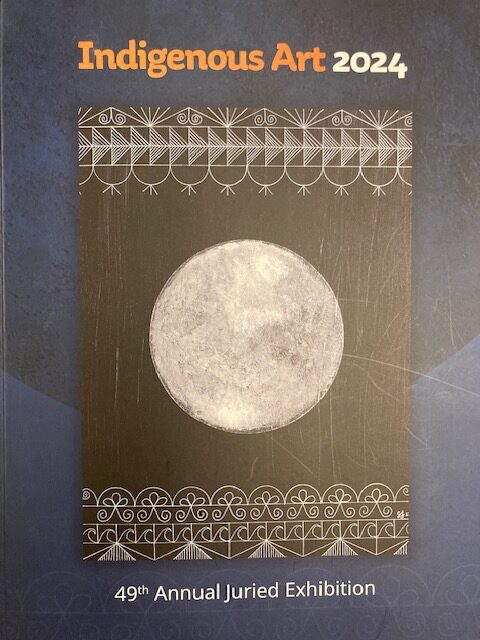
The Woodland Cultural Center’s annual juried show brings together a wide array of Indigenous contemporary artists to share their stories, passions and talents. Offering the opportunity for
visitors to learn and appreciate Indigenous knowledge, while creating awareness of current social, and political movements and perspectives from various Indigenous communities from both sides of the border. Embracing values associated with the Good Mind: Ka’satsténshsera, emerging, mid-career and established artists have submitted work ranging from acrylic or oil paintings on canvas to sculpture, beading, photography, watercolour, stained glass, mixed media and pyrography on wood.
The 2024 exhibit explores themes such as relationship to place, protest, family, fashion, dance, law and the environment, reflecting the rich tapestry of Indigenous experiences.
In the catalogue, you have an opportunity to hear from curator Patricia Deadman, and jurors Rachelle Dickenson, David General, and Maxine Noel, all highly accomplished in their field.
Each of the art pieces is photographed, and a directory of all artists including biographies and illuminating descriptions of the artworks is provided.
By December of this year, the WCC’s gift shop hopes to offer the 50th Anniversary Catalogue: Indigenous Art 2025. I recommend making a trip to visit the Mohawk Institute in Brantford for a tour of the newly renovated interpretive centre, followed by a visit to the Woodland Cultural Centre, next door. If you can, attend in Summer/Fall to take in Indigenous Art 2026. There will be much to discover.